
Thanksgiving week: the ETA promise is part of the job
November 24, 2026Tire changes on a holiday shoulder: when the answer is no
Road Service Report · Service Call Skills
Holiday traffic puts more cars on the shoulder, and more drivers in a hurry beside them. In 2024 there were about 33,000 crashes on road shoulders, and 578 of them were fatal (Traffic Safety Marketing, NHTSA).
What it means on the call
A flat tire feels like an easy call. That is the trap. The tire is easy. The shoulder is not. The AAA Foundation found that 89% of roadside workers killed from 2015 to 2021 died where the speed limit was 55 mph or higher (AAA Foundation).
So the first question is not “where is the jack point.” It is “should this tire be changed here at all?”
The skill: four reasons to say no
Our Scene Size Up job aid lists four conditions where you refuse the tire change where the car sits:
-
The car is in an active lane.
-
Traffic is 55 mph or faster and you have no traffic control.
-
Visibility is under 500 feet.
-
The customer will not move to a safe spot.
When one of these is true, you have choices: move the vehicle to a safer spot, tow it, or stop work. Say it plainly: “I am pausing this service for safety. I am contacting dispatch now.” That is not a service failure. It is the job done right.
When the scene is safe: setup
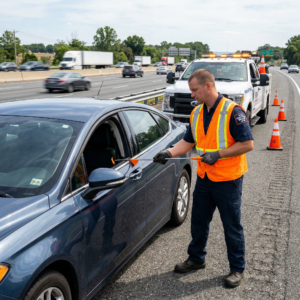
If the scene passes, set it up the way the Roadside Tire Change job aid shows:
-
Service vehicle at 45 degrees. Warning devices at 10, 100, and 300 feet.
-
Class 2 vest, Class 3 within 50 feet of traffic.
-
Firm, level surface. Parking brake set. Vehicle in Park or in gear.
-
Chocks on the opposite axle, firmly wedged, not loosely sitting.
Then work the sequence: break the lugs loose with the tire on the ground, jack only at the manufacturer’s point, set a jack stand as backup, mount the spare in a star pattern, and make a final torque pass at 80 to 100 ft lbs for a passenger car.
The closeout most drivers skip
The customer is about to drive off on a spare on the busiest weekend of the year. Tell them what they need to know:
-
Check spare pressure with a calibrated gauge. A compact spare is 60 PSI max.
-
A compact spare is good to 50 mph, not for long distances.
-
The TPMS light is normal.
Then complete and sign the service report: flat condition, spare type, torque spec. If something goes wrong down the road, that record is your proof.
Where to learn it
The Roadside Tire Change lesson, plus specialty wheels, lockouts, jump starts, and fuel delivery, are in Roadside Service Procedures at Tow Truck University®, $119.00. The Scene Size Up rules above are also sold alone as a Scene Size Up Refresher for $29.99. Finish it on your phone between calls. See Roadside Service Procedures · See the Scene Size Up Refresher
A word on pressure
On a holiday, the customer wants to be back on the road now. Dispatch wants the call closed. You want to get to the next one. That pressure is exactly when people skip the size up. Take the ten seconds anyway. Read the traffic, the light, the road, the hazards, and your exit before you touch a door handle. Then decide.
Get home tonight. Have a safe Thanksgiving.
Sources: Traffic Safety Marketing: Move Over · AAA Foundation roadside responder fatalities summary
Built for this call
Learn the full skill
Roadside Service Procedures
$119.00 · Finish it on your phone
Lockouts, jump starts, tire changes, and fuel delivery to a defensible professional standard.
Start the course
Scene Size Up Refresher
$29.99 · Finish it on your phone
Before you ever step out of the truck, you assess, evaluate, and decide. This lesson gives you the TIM framework, five assessment factors, and the three…
Start the courseRunning a crew? Ask about one price for your whole roster.
Keep reading
