Your website says trained and certified. Can you show it?
November 17, 2026Holiday parking lot lockouts: no proof, no service
Road Service Report · Service Call Skills
The holiday shopping season is here. Crowded lots, cold hands, arms full of bags, and keys left on the seat. Lockout calls pick up, and so do the ways a lockout can go wrong.
What it means on the call
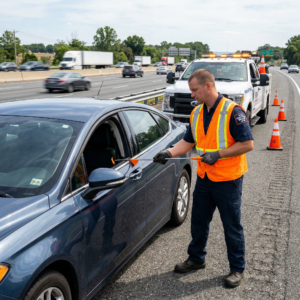
A lockout looks like the easiest call you will run. It is also one of the easiest to get sued over. Opening the wrong person’s car, scratching paint, or bending a door frame turns a quick call into a claim. And once in a while, a lockout is not about keys at all. It is about a child or a pet inside a hot or cold car.
Our two lockout lessons cover both sides: the routine call done right, and the emergency done fast.
The skill: verification and risk
Before you touch anything
-
Verify ownership with a registration, insurance card or matching ID. No proof, no service.
-
Do a four-sided walkaround and photograph all preexisting damage before you touch the vehicle.
-
Classify the vehicle. German luxury, EV, large truck or SUV, convertible, or under a year old? Adjust your approach or call dispatch.
During entry
-
Plastic protectors on all painted surfaces before any tool contacts the door.
-
Air wedge on the hinge side, no more than a half-inch gap, pumped slowly.
-
No slim jim on any vehicle after 2000 without model-specific training.
-
Feel resistance? Stop. Reassess. Never force it.
Closeout
-
Final photo of the door closed and undamaged.
-
Customer signature on the service ticket.
-
Submit all photos and documentation before you leave the scene.
When a lockout becomes an emergency
If you arrive and a child or a pet is locked inside, our Emergency Override lesson is clear: this is a life safety emergency.
-
Call 911 immediately, before any entry attempt.
-
Keep the parent or owner calm. Keep yourself calm.
-
Watch for signs of distress: unresponsiveness, labored breathing, disorientation, collapse. Relay what you see to the 911 operator.
-
If it becomes immediately life threatening and EMS is not on scene, the lesson says break the rear window furthest from the child or animal.
-
Afterward, notify your dispatch supervisor right away and document arrival time, observations, the 911 call time, what you did and the outcome. Follow your motor club’s own emergency protocol.
Keeping a stressed customer calm
Holiday lockouts come with stressed people: groceries thawing, kids in tow, a schedule falling apart. Our customer lessons start with the human before the vehicle. Walk directly to the customer, use their name, and tell them who you are. If they are frustrated, give them 10 to 20 seconds to talk without interrupting. Then try a line from our De-Escalation lesson: “I can see why this is frustrating. Let’s get you taken care of.”
Explain what you are about to do before you do it, especially the ID check. Customers rarely argue with proof of ownership once they hear it protects their car from someone else.
For owners
Lockout damage is one of the most common avoidable claims. A driver who photographs before and after, and gets a signature, gives you a defense. A driver who does not gives you a bill.
Where to learn it
Both lockout lessons are part of Roadside Service Procedures ($119.00), along with jump starts, tire changes, specialty wheels and fuel delivery. Each lesson has a one-page job aid built to keep in the truck.
Built for this call
Learn the full skill
Roadside Service Procedures
$119.00 · Finish it on your phone
Lockouts, jump starts, tire changes, and fuel delivery to a defensible professional standard.
Start the course
Customer Experience
$99.99 · Finish it on your phone
Professional presence, delay communication, de-escalation, and the closeout that earns the survey.
Start the courseRunning a crew? Ask about one price for your whole roster.
Keep reading