
Tow Truck University
August 22, 2025
Clocks fell back. Your night setup has to grow with them
November 5, 2026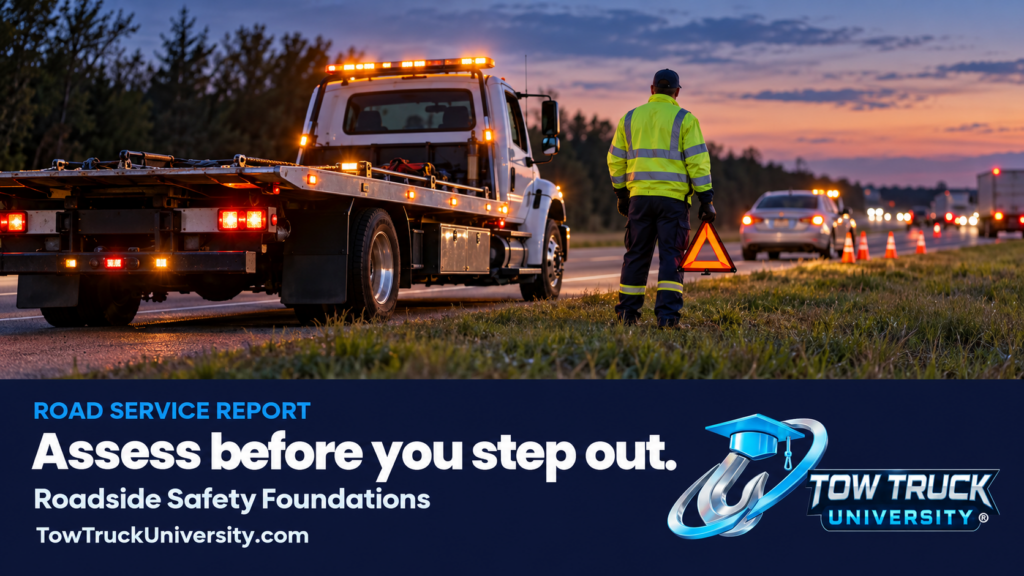
Crash Responder Safety Week: the first 90 seconds decide the rest
Road Service Report · Safety Watch
This week is Crash Responder Safety Week, November 2 to 6, 2026. The national theme is “Slow Down, Move Over. Lives are on the Line!” On October 17, the International Towing Museum added 20 names to the Wall of the Fallen. Each name is a tow operator who went to work and did not come home.
Why this week matters to you
The numbers are hard to read. The AAA Foundation for Traffic Safety counted 123 roadside assistance workers struck and killed from 2015 to 2021. The yearly count rose from 10 to 26 over that stretch. Of those deaths, 63% happened in darkness and 89% happened where the speed limit was 55 mph or higher. The same study found that federal crash data caught only about a quarter of these deaths, so the real picture is likely worse.
In September, a 26-year-old Connecticut tow operator, Alex Ramos, was struck and killed while working a tow in Bloomfield. His family is still asking for answers. We name him here with respect, and to remind every driver reading this that the shoulder is a work zone that does not look like one.
You cannot control the driver coming up behind you. You can control what that driver sees, and how early they see it.
What it means on the call
Most of the danger is packed into the first minutes on scene. You are stepping out, the motorist is confused, and traffic has not adjusted yet. The goal is simple: get the warning out before you get out, and get it far enough back that a driver at highway speed has time to react.
Our Warning Devices lesson teaches a 90-second deployment. Our Scene Size Up lesson teaches what to read before you touch a door handle.
The skill: read five, then deploy in 90 seconds
Before you open your door, read five things:
-
Traffic: speed, volume, how close the lane is
-
Lighting: time of day, glare, sight distance
-
Road: wet, ice, debris, grade, curve
-
Hazards: fuel, wires, an unstable vehicle, bystanders
-
Exit: know your way out before you go in
Then the 90-second setup from the job aid:
-
Amber on. Assess. Exit on the protected side.
-
First triangle at 10 feet, then a protected walk back to 100 feet.
-
Far triangle at 200 to 300 feet on a divided road, 500 feet at 55 mph or more, and beyond any crest or curve. On a two-lane road, cover both directions.
-
Taper: the speed limit in feet, 6 cones, and a buffer of 20 to 50 feet.
-
Get the customer off the roadway, on the protected side.
-
Take four direction photos and log the time you deployed.
If the scene will not let you do this safely, you have stop work authority. Say it plainly: “I am pausing this service for safety. I am contacting dispatch now.” That is not a service failure. It is the job done right.
For owners
Crash Responder Safety Week is a good week to ride along on one call and watch the first 90 seconds. Does your driver deploy before stepping into the lane? Are the triangles in the truck in date and intact? A pre-shift log takes two minutes and gives you a record that the gear was checked.
Where to learn it
The full scene safety sequence lives in Roadside Safety Foundations ($119.00), which covers scene size-up, vehicle positioning, warning devices, night operations and PPE. If a driver needs just the assessment piece, the Scene Size Up Refresher is $29.99 and finishes on a phone between calls.
See Roadside Safety Foundations · Compliance Refreshers
Slow down. Move over. Get home tonight.
Sources: NOCoE, Crash Responder Safety Week · AAA Foundation summary · NewsChannel 9, Wall of the Fallen · WFSB, Bloomfield
Built for this call
Learn the full skill

Roadside Safety Foundations
$119.00 · Finish it on your phone
Scene safety, positioning, warning devices, PPE, and conduct standards. The foundation course for every roadside professional.
Start the course
Scene Size Up Refresher
$29.99 · Finish it on your phone
Before you ever step out of the truck, you assess, evaluate, and decide. This lesson gives you the TIM framework, five assessment factors, and the three…
Start the courseRunning a crew? Ask about one price for your whole roster.
Keep reading