Crash Responder Safety Week: the first 90 seconds decide the rest
November 3, 2026
The top complaint about tow service is silence
November 10, 2026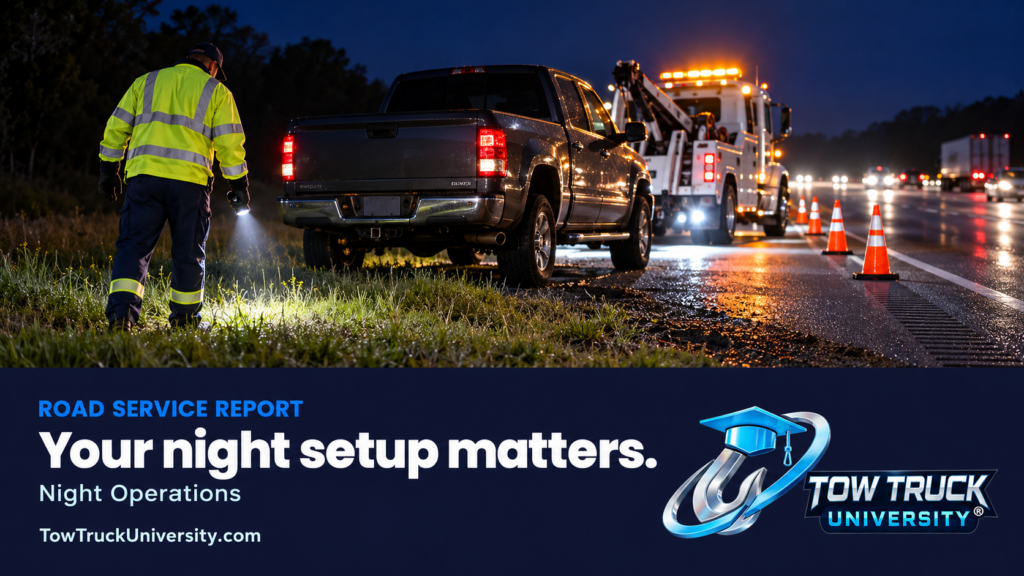
Clocks fell back. Your night setup has to grow with them
Road Service Report · Safety Watch
Daylight saving time ended Sunday, November 1. For most drivers that means the evening rush now happens in the dark, and a lot more of your calls do too.
Why the dark changes the math
The AAA Foundation found that 63% of the roadside workers struck and killed from 2015 to 2021 were hit in darkness. That is not because night drivers are worse people. It is because they see you later, judge distance worse, and are more likely to be tired or impaired.
A setup that works at noon is too short at 6 pm. The fix is not complicated, but it has to be a habit before the first cold night shift.
What it means on the call
Three things change at night: how far back your warning has to start, where your light goes, and how you watch yourself for fatigue. Our Night Operations lesson covers all three.
The skill: the night setup
Gear and lights
-
Class 3 gear, inspected, with clean reflective tape. Dirty tape does not reflect.
-
Work lights aimed down 65 to 75 degrees, off the lane. You want light on the work, not in a driver’s eyes.
-
Arrow board angled off oncoming drivers. Glare shields on light towers.
-
A reflective collar on every cone and device.
Distance
-
Buffer space grows with speed: about 160 feet at 45 mph, about 240 feet at 55 mph, about 320 feet at 65 mph.
-
Night taper spacing is about 35 feet between devices at 55 mph.
-
The Vehicle Positioning lesson has a simple rule: at night, add 25% to your setup.
-
Walk the taper at headlight height and look back. If you cannot see it from the driver’s seat, neither can they.
Work the safer side. Use the truck as your barrier.
Watch yourself, too
Fatigue is a night hazard of its own. The job aid lists the signs: microsleep, slowed speech, irritability. Take a break every 2 hours on a long night, and buddy up when you can. If visibility drops under 500 feet with high wind and rain, the lesson says suspend the work and call it in.
Breaking down
Night breakdown is where tired operators get hurt. Remove the downstream devices first. Recover and inspect each one. Secure your lighting. Then make one final drive-through to confirm nothing was left behind in the lane.
A quick self-check before your first night shift
-
Is my reflective tape clean, or is it grimy from summer?
-
Do I have a 36-inch cone set aboard for night, and are the sleeves bright?
-
Are my LED flares charged and my regular flares in date and dry?
-
Do my work lights aim down, or did someone knock them up into traffic?
-
Did I sleep? If the answer is no, say so before you take the truck.
None of this takes long. All of it decides whether the driver coming over the hill sees you at 500 feet or at 50.
For owners
The week after the time change is a good moment to check every truck for 36-inch cones, charged LED flares, and working arrow boards. A two-minute pre-shift check now saves you a bad call later.
Where to learn it
The Night Operations Refresher is $29.99 and covers this whole setup, start to breakdown. It finishes on a phone. For the full scene safety picture, including positioning and warning devices, see Roadside Safety Foundations ($119.00).
Sources: FOX 5 DC, daylight saving time 2026 · AAA Foundation summary
Built for this call
Learn the full skill
Night Operations Refresher
$29.99 · Finish it on your phone
At night the driver bearing down on you sees less than you think, and later than you hope. Learn how night vision actually works, what buffer…
Start the course
Roadside Safety Foundations
$119.00 · Finish it on your phone
Scene safety, positioning, warning devices, PPE, and conduct standards. The foundation course for every roadside professional.
Start the courseRunning a crew? Ask about one price for your whole roster.
Keep reading